
Designing In Vivo CAR-T with the Inceptive Platform
.jpg)
At Inceptive, we build foundation models for sequence-based medicines. In vivo CAR-T is one of the most compelling areas for our zero shot de novo design approach.
In less than one month, with minimal CAR-T-specific training data, our models designed mRNA sequences that matched industry-leading benchmarks in PBMC expression and killing. Performance carried beyond cell culture, with our sequences achieving near-complete in vivo B-cell aplasia using a partner’s proprietary passive-targeted LNP.
And when we iterated further, our sequences moved from matching benchmarks to exceeding them.
This is the promise of zero-shot de novo design: models that aren’t trained specifically for a target can still quickly produce best-in-class sequences that lead to better medicines. This enables models to generalize across new domains and new targets with unprecedented speed.
In vivo CAR-T's untapped potential
In vivo CAR-T has shown curative potential for challenging cancers and autoimmune diseases. It’s one of the most promising modalities in medicine, but we've only scratched the surface of what it can accomplish for patients. Most of the therapeutic space remains unexplored. To take in vivo CAR-T to the next level and reach far more people, we need to improve sequence design to drive the right expression, duration, and specificity.
That's the kind of design challenge Inceptive's models are built to solve.
Inceptive models train on heterogenous data to generalize across biology
Zero-shot de novo design is possible because our models don't start from scratch for each new therapeutic area.
Our approach starts the same way large language models do: learning the underlying rules of biology from massive amounts of data spanning sequence, function, and structure. This gives models an understanding of how life works before they see target-specific data, enabling them to generalize more readily. We then fine-tune using smaller quantities of task-specific experimental data, turning a general biological model into design tools for individual therapeutic applications.
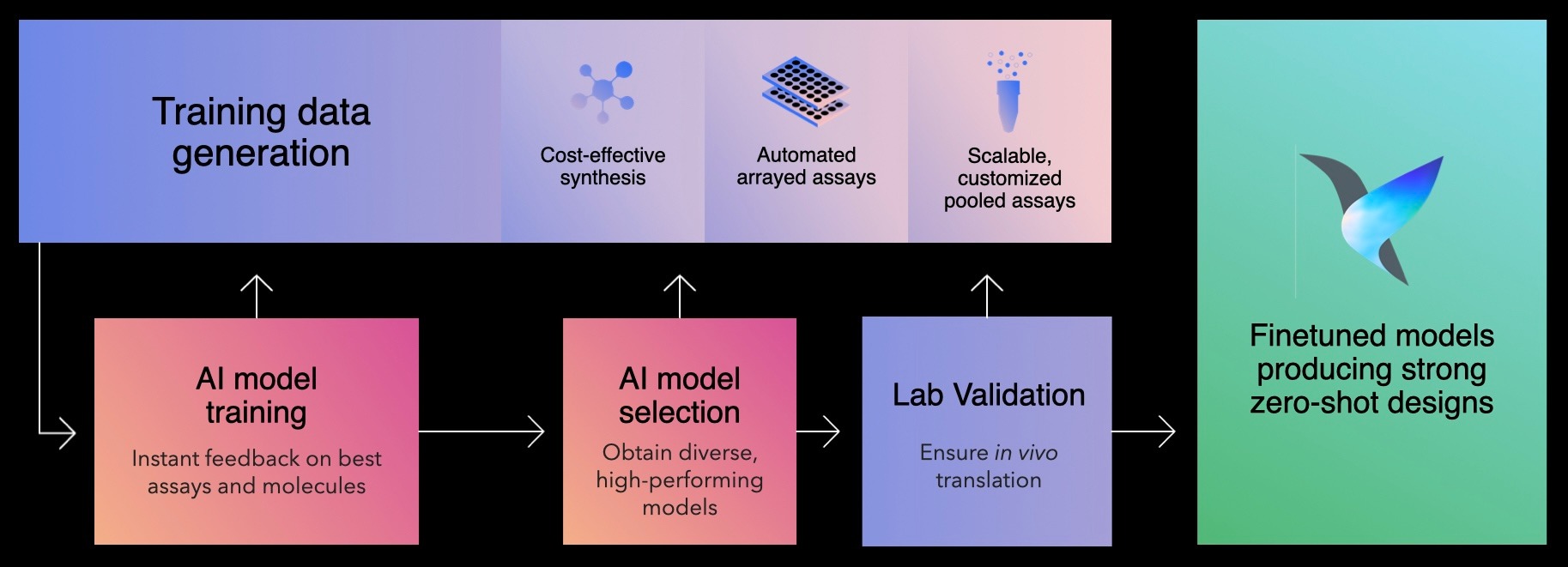
We improve models with a continuous data generation and learning loop. Models design sequences, predict their properties, and help prioritize which experiments will be most valuable. Selected sequences are synthesized and tested in our lab using automated high throughput arrayed and pooled assays, with the resulting data fed back into retraining.
This is not a standard build–test cycle. Our models actively help determine which experiments to run and how to adapt each iteration, so every data point makes the next one more valuable. We ensure models stay tethered to reality by validating them with gold-standard in vitro and in vivo assays.
Inceptive's zero-shot in vivo CAR-T designs match industry leaders from day one
Zero-shot de novo Inceptive designs, including the creation of novel UTRs, equaled leading anti-CD19 CAR-expressing industry sequences in PBMC expression and killing assays in a fraction of the time, using a fraction of the resources. Crucially, this performance carried beyond cell culture, with our sequences achieving near-complete in vivo B-cell aplasia when combined with Mana.bio’s proprietary passive-targeted LNP.
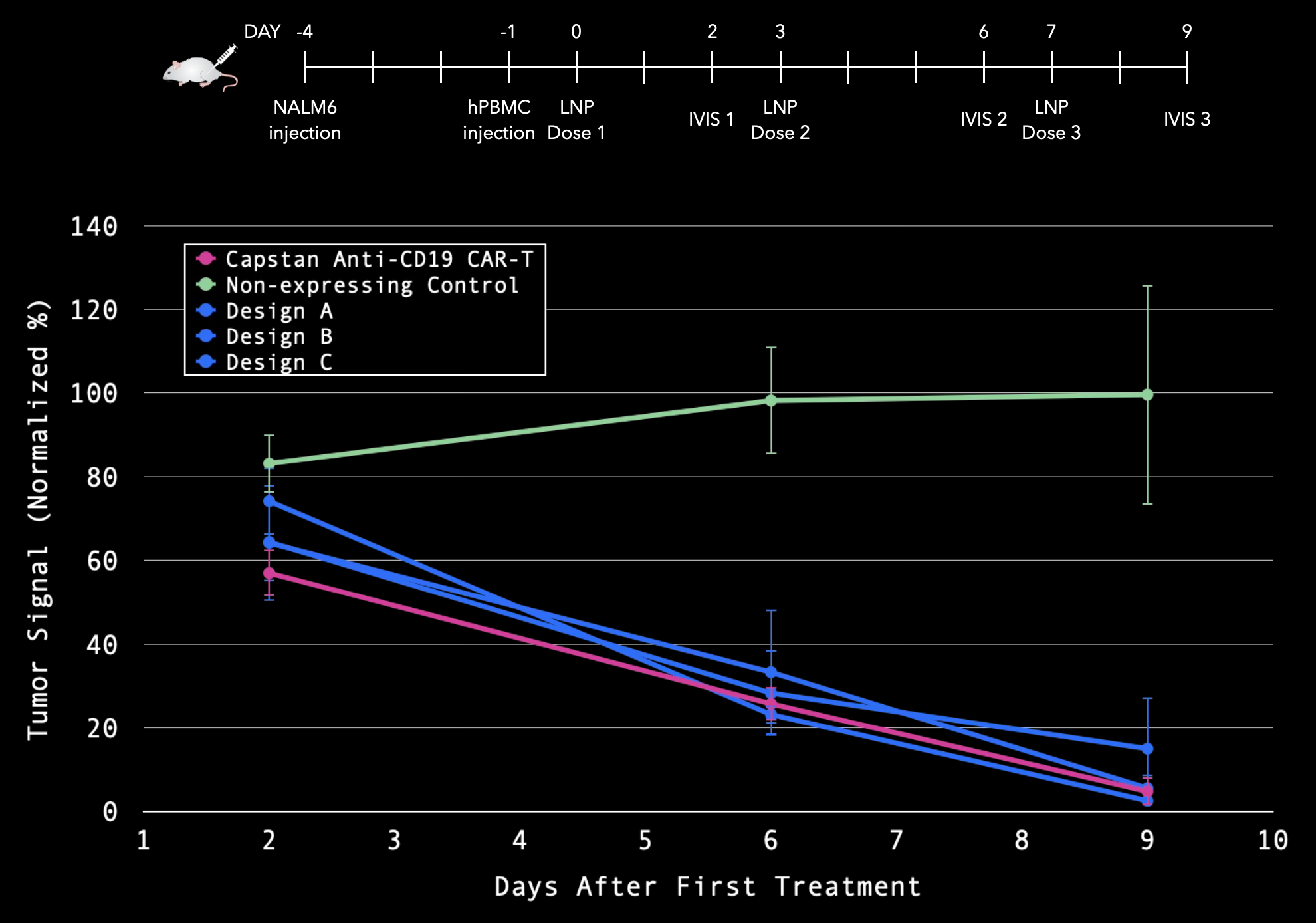
Conventional approaches rely on laborious wet lab iteration with large screening experiments. Capstan Therapeutics, one of the companies acquired in the recent wave of high-value in vivo CAR-T acquisitions, represents the current benchmark for mRNA-LNP in vivo CAR-T. Their sequences are the product of extensive development, with iterative rounds that include primary and secondary screening as well as hit validation.
Inceptive matched that performance in under a month, with minimal fine-tuning data and without any large-scale wet lab screening. These zero-shot results point to a new drug development paradigm, where foundation models can generalize into new therapeutic spaces quickly, producing competitive, novel designs at lower cost.
Zero-shot generalization as a multiplier
A key test of any AI platform is generalizability: how well does it perform on problems it has never seen? Our zero-shot model performance extends.
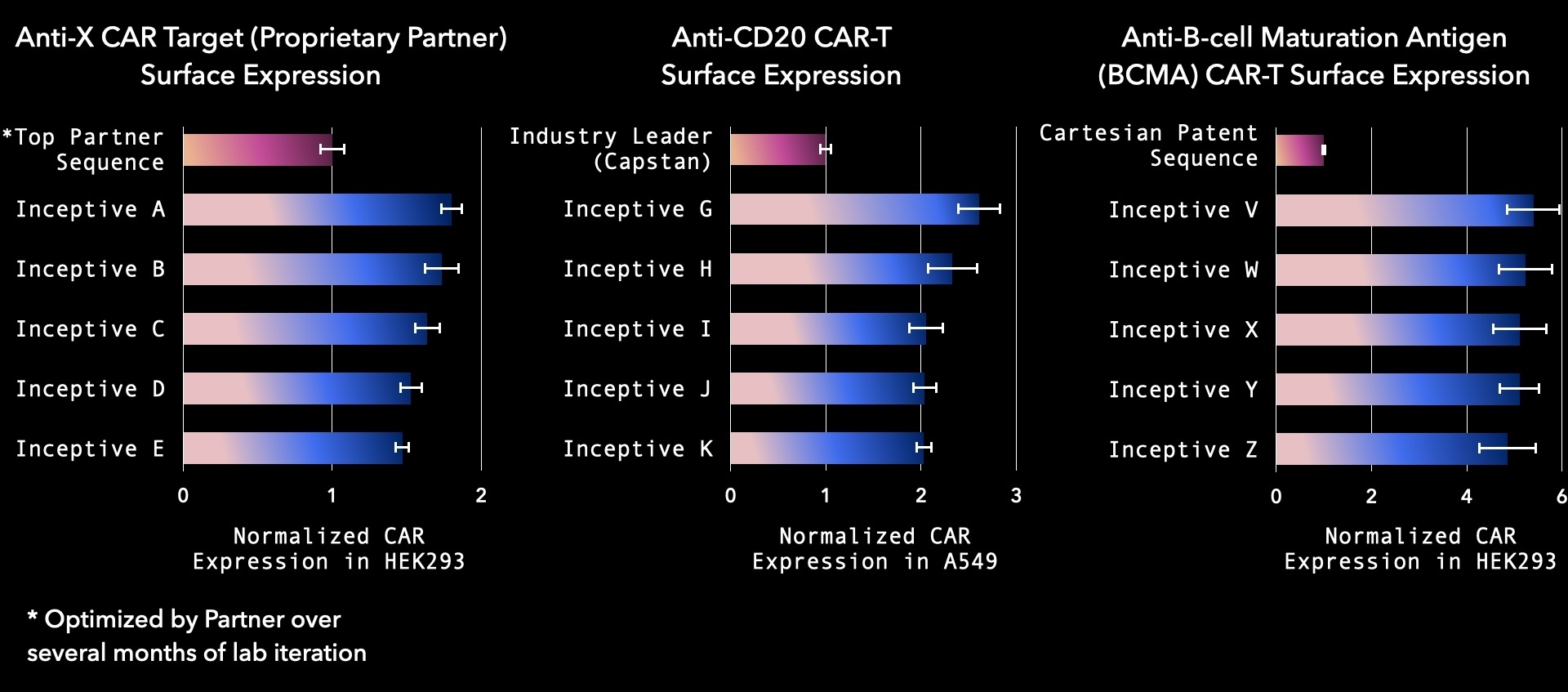
Across different CAR targets, our models’ zero-shot designs exceeded the performance of established industry benchmarks. Instead of restarting development for every new target, our models enable starting from a strong baseline, accelerating development and increasing the likelihood of success.
In collaboration with a commercial partner, Inceptive models were tasked with designing mRNA sequences for a new proprietary CAR protein, with no additional training data or exposure to partner sequences. The resulting designs outperformed the partner's own best sequence, which had been optimized over months of iterative development.
This carryover of model performance was separately replicated for BCMA and CD20, two of the most clinically relevant targets in hematologic malignancies. In each case, Inceptive models produced de novo designs that exceeded optimized industry sequences, without exposure to data for the specific target.
Running parallel programs on different targets used to be cost and time-prohibitive. Inceptive's zero-shot generalization changes the calculus for drugmakers.
Inceptive models are a new way to design medicines
Instead of searching for top hits through a slow, expensive process of iterative screening, we can design them quickly using models that efficiently adapt to new problems by learning directly from data. This approach is changing how our partners pursue targets and indications, and ultimately we believe it will improve patient access to lifesaving medicines.
These CAR-T results were just an early proof point for our platform. In subsequent rounds, our sequences continued improving. We’ll be sharing more of those results soon.
Authors: Alexander Hawkins-Hooker, Alexey Dosovitskiy, Artem Korkhov, Benedetta Bernasconi, Camille Bayas, Carin Rahmberg, Charles Limouse, Christopher Alford, Denny Ha, Dan Cao, David Feldman, Dirk Weissenborn, Edmundo Vides, Fernando Pereira, Gabriela Roman, Henning Meyer, Herschel Dhekne, Ibrahim Abdullah, Jamey Iaccino, Jean-Baptiste Cordonnier, Jakob Uszkoreit, Jimin Park, Jonathan Ronen, Karin Schöfegger, Kevin Green, Kyle Fukui, László Lukács, Lily Blair, Marie Teng-Pei Wu, Monique Kerstens, Noha Radwan, Parissa Monem, Pratima Rao, Rico Jonschkowski, Rishi Misra, Sheena Yiu, Shengya Cao, Tara Basu Trivedi, Tamson Moore, Thomas Lozanoski, Tibor Rothschild